
Entry discipline: Signal Band and density limits
A single stretch can generate a burst of signals in the same place. Three independent brakes — the validity band, a per-candle limit and a minimum distance — turn a cloud of entries into planned installments.
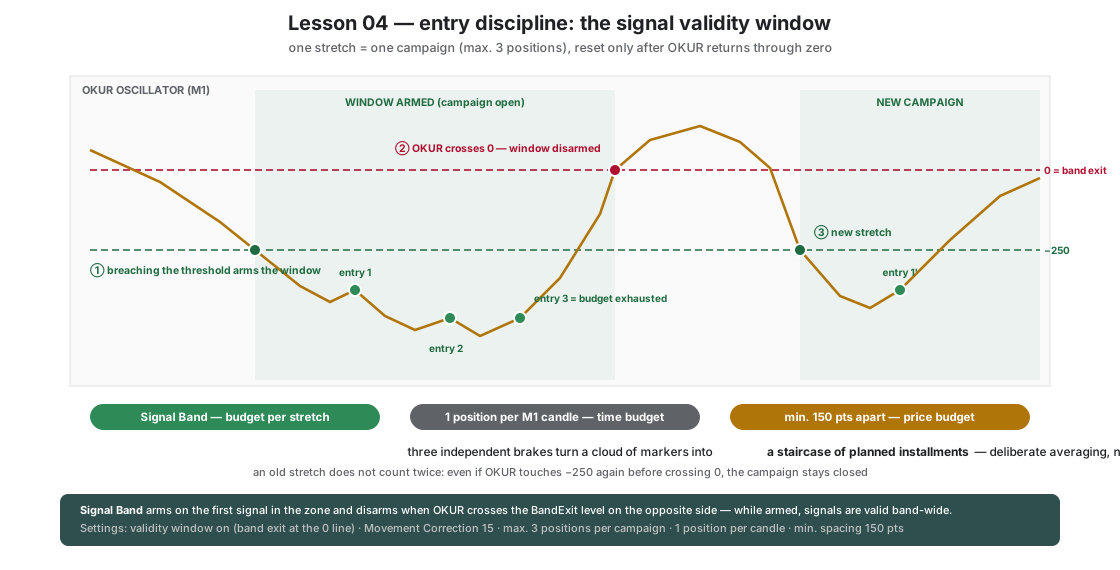
A single deep stretch can generate a burst of signals — the oscillator ripples at the extreme and keeps satisfying the rebound condition. Without discipline the EA would open several positions in the same place, multiplying the risk of a single decision. This lesson adds three independent brakes:
- Signal Band (validity band) — the signal “arms” on the first entry into the zone and stays valid until OKUR crosses the
BandExitlevel (here: 0, the midline). Only a full return of the oscillator through zero “disarms” the zone — further signals become possible only from a NEW stretch. One stretch = one campaign. - Max Positions per Bar — at most 1 opening per M1 candle: no bursts within a single candle.
- Min Self Distance — the next position of this button must be at least 150 pts (1.5 USD) away from the previous one: add-ons only at a genuinely better price, not in the same place.
What is switched on, and why
| Feature | Value in the set | Role |
|---|---|---|
B1_BandEnabled=true, B1_BandExit=0 | band from the ±250 threshold to the 0 line | one stretch = one series of entries, reset only after OKUR passes through 0 |
B1_Movement_Correction=15 | raised from 5 | fewer nervous signals inside the band |
B1_MaxPositionsPerButton=3 | 3 | the campaign has a budget: at most 3 positions |
B1_MaxPositionsPerBar=1 (factory) | 1 per M1 candle | stretches the campaign out in time |
B1_MinSelfDistance_points=150 | 150 pts | stretches the campaign out in price |
| BE/TS from lesson 02 | unchanged | each campaign position is managed separately |
How it makes price behavior visible
A stretch on gold is almost never a single point — it is a process: a down wave, a shallow rebound, a second wave deeper, and only then the reversal. The validity band maps this process directly:
- The first break of the −250 threshold arms the band — the campaign is open.
- Each subsequent wave down, as long as it moves price by ≥150 pts, can add a position (max 3) — we average deliberately, in planned installments, not in panic.
- OKUR’s return through 0 says: the stretch is consumed, the campaign is closed. Even if the oscillator brushes −250 again a moment later, the band requires a fresh disarm — the old stretch does not count twice.
On the chart you will see a clear change in the character of the record: instead of a cloud of markers in one place — at most three entries laid out in steps into the depth of the move.
What to watch on the chart
- The band-exit line in the oscillator window and the moment the band “disarms”.
- The add-on steps every ≥150 pts — compare with lesson 03, where there was no limit.
- Situations where the budget of 3 positions ran out before the bottom — this is the price of discipline; count how often it protected and how often it cost.
Next step
Lesson 05: quantitative discipline does not protect against entering AGAINST THE CURRENT. Time for the first directional filter — the MMD trend clouds.
B1_BandEnabledB1_BandExitB1_MaxPositionsPerButtonB1_MaxPositionsPerBarB1_MinSelfDistance_points
Load these in MetaTrader 5 via F7 → Load to reproduce the lesson exactly. Since release 2.04 the lesson sets switch the robot on when loaded (an orange “Trading ON from .set” bar shows under the panel title); if you switched the robot off with OFF during an earlier lesson, click ON in the panel's top row — the next set does not undo your click. Available to signed-in users with an active licence.
Educational material, not investment advice. The sets are teaching examples — before any live use, test on real ticks and tune to your own account. Reference deposit 1000 in account currency, lot 0.01; scale money values proportionally to your balance.