
Managed exit: Break Even and Trailing Stop
The same entry as in lesson 01, but the position stops passively waiting for the SL or TP — Break Even secures the entry, and the Trailing Stop follows the move.
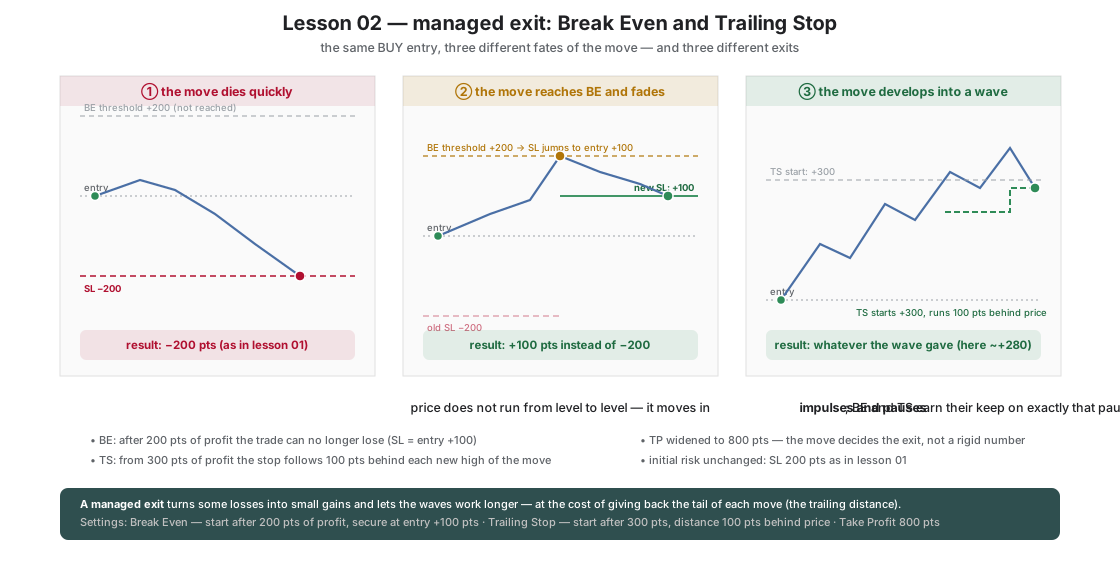
The entry from lesson 01 stays unchanged. What changes is the exit: instead of passively waiting for price to hit the SL or TP, the position starts being managed. Two mechanisms:
- Break Even (BE) — once the position earns
BE_Startpoints, the Stop Loss jumps to the entry price +BE_Gain. From that moment the trade can no longer end in a loss. - Trailing Stop (TS) — once profit reaches
TS_Start, the Stop Loss starts following price at a fixed distanceTS_Distance, tightening at every new high of the move.
What is switched on, and why
| Feature | Value in the set | Role in the lesson |
|---|---|---|
Break Even (B1_BE_Enabled=true) | start 200 pts, gain 100 pts | after 2 USD of movement the SL jumps to entry +1 USD |
Trailing Stop (B1_TS_Enabled=true) | start 300 pts, distance 100 pts | from 3 USD of profit the stop follows 1 USD behind price |
Take Profit (B1_TakeProfit=800) | widened from 400 to 800 pts | we give the trailing room — let the move decide how much it gives back |
Stop Loss (B1_StopLoss=200) | unchanged | the initial risk is identical to lesson 01 |
Virtual SL/TP (Global_VirtualSL/TP=true, factory) | enabled | the levels are held in the EA’s memory, invisible to the broker — server-side stops are the subject of lesson 10 |
How it makes price behavior visible
A move on XAUUSD rarely runs in a straight line — it gives back along the way. This lesson shows three typical biographies of the same trade:
- The move dies quickly — price reverses before reaching 200 pts: the position ends at the full SL, exactly as in lesson 01. BE/TS had no time to do anything.
- The move reaches the BE threshold and fades — the SL already stands at entry +100: a trade that in lesson 01 would have ended at −200 becomes +100. This is the most common and most instructive case: the market “gave back” everything, but we were already safe.
- The move develops into a wave — the trailing walks the stop up with each new high; the exit happens not at a rigid TP, but where the wave actually pulled back by 100 pts. On the markers, compare the result with a hypothetical rigid TP of 400 — sometimes the trailing takes more, sometimes it gives back part of the move.
Putting these three cases side by side is a practical definition of volatility: price does not move from level to level, but in waves of impulses and pauses — and it is exactly on that pause that BE/TS earn their keep.
What to watch on the chart
- The moment the SL jumps to break even (EA log
[BE]+ level marker). - The step-by-step tightening of the stop by the trailing on longer waves.
- Trades “rescued” by BE that would have been a loss in lesson 01.
Next step
Lesson 03: since a move is made of an impulse and a correction, the same entry can be read two ways — on the pullback or on the deepening. Two buttons will show both geometries at once.
B1_BE_EnabledB1_BE_Start_pointsB1_BE_Gain_pointsB1_TS_EnabledB1_TS_Start_pointsB1_TS_Distance_points
Load these in MetaTrader 5 via F7 → Load to reproduce the lesson exactly. Since release 2.04 the lesson sets switch the robot on when loaded (an orange “Trading ON from .set” bar shows under the panel title); if you switched the robot off with OFF during an earlier lesson, click ON in the panel's top row — the next set does not undo your click. Available to signed-in users with an active licence.
Educational material, not investment advice. The sets are teaching examples — before any live use, test on real ticks and tune to your own account. Reference deposit 1000 in account currency, lot 0.01; scale money values proportionally to your balance.